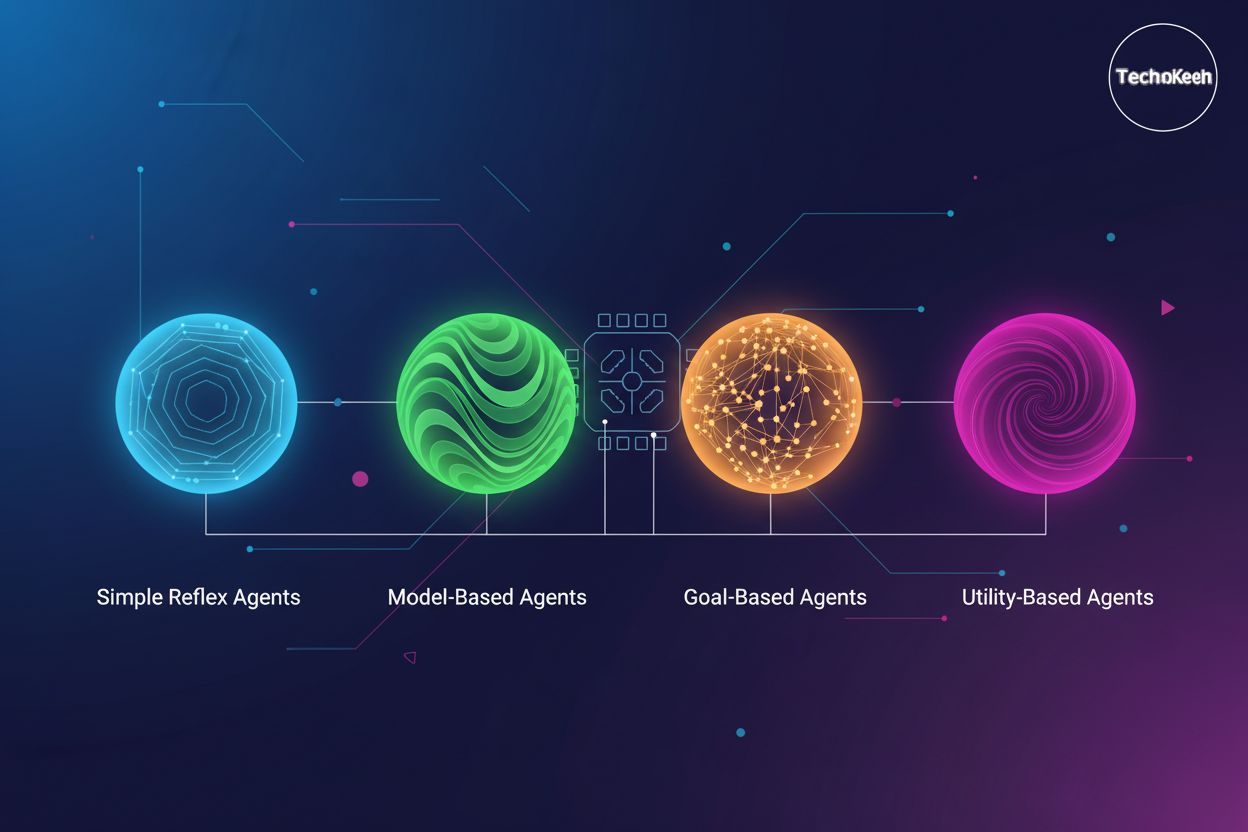
Identifying the Four Types of AI Agents
TL;DR
- This article covers the four primary types of AI agents: simple reflex, model-based reflex, goal-based, and utility-based agents. It explores how each agent type perceives its environment, makes decisions, and achieves specific goals; further detailing real-world applications and highlighting the strengths and weaknesses of each type to help businesses choose the right agent. The article also touches on the importance of ethical considerations and governance when deploying AI agents.
Introduction to AI Agents
Ever wonder how ai actually does stuff? Well, ai Agents are a big part of the answer. They're basically the brains behind the operation, perceiving and acting – like, imagine a super-smart robot.
In this guide, we'll explore the different types of AI agents, starting with the simplest.
Key characteristics include:
- They observe their surroundings to gather data, which then enables them to automate tasks based on that information.
- They drive decision-making processes.
- Crucial for effective ai development, deployment, and comprehension. (Taking The Practical Steps To AI Deployment - Forbes)
Think of them as digital workers.
Simple Reflex Agents: The Basics
So, simple reflex agents – they're like the toddlers of the ai world, y'know? Reacting to whatever's right in front of them. They get the job done, but don't expect too much.
These agents operate based on:
- They work using if-then rules. If this happens, then do that. It's pretty straightforward. Think of a thermostat: if it gets too cold, it turns on the heat.
- They struggle in complex situations. If things get too complicated, or the environment changes a lot, they fail to perform the correct action or produce an incorrect output. For instance, a simple reflex agent in a game might not be able to strategize beyond immediate moves, unlike a more advanced agent.
- They're used in stuff like spell checkers. raia AI notes that it's great for things with straight-line logic.
They're definitely not gonna win any ai awards, but hey, everyone starts somewhere, right? Next, we'll explore Model-Based Reflex Agents, which build upon these basic principles.
Model-Based Reflex Agents: Adding Memory
Okay, so Model-Based Reflex Agents are where things start gettin' interesting, right? These aren't your dumb "if-this-then-that" robots. They actually remember stuff.
They keep an internal model of the world, which is a fancy way of saying they have memory. This model typically contains information about the environment's state, past observations, and predictions. By maintaining a model of the world's state, they can predict or infer aspects of the environment that are not currently observable through their sensors. This lets them handle situations where they can't see everything at once.
Think of self-driving cars: they don't just react to the car right in front of them. They remember that they were in the left lane and wanted to merge right, so they keep planning for it.
I think it's interesting, they’re way better than the simple ones when things get complicated. A simple thermostat just reacts to the current temperature, but a model-based one can learn your schedule and adjust accordingly.
One thing to remember, though: you gotta train these models and keep 'em up-to-date. The internal model is learned from data, and the environment can change, requiring the model to be updated to remain accurate. Otherwise, they get confused, leading to incorrect predictions or poor decisions.

These agents are a big step up. Next, we'll talk about goal-based agents.
Goal-Based Agents: Planning for the Future
Goal-based agents are all about planning, right? They don't just react; they think ahead to achieve a specific result. It's like they've got a roadmap in their head.
- They aim for specific goals, and they plan what to do to get there. Planning involves searching for a sequence of actions that leads to the goal. Think of a robot trying to win a game; it figures out each move to beat you.
- They are flexible and can change their plans if things don't go as expected. Like, if the GPS tells you there's traffic, it will find another route. This flexibility is achieved through replanning when unexpected events occur.
- You see these agents in navigation systems and in ai that plays games. raia AI mentions that goal-based agents are driven by the end destination.
This proactive approach offers significantly more utility than simple reactive behaviors. Next up, we'll dive into utility-based agents.
Utility-Based Agents: Optimizing for the Best Outcome
Utility-based agents? These are the ones that really make things happen. They don't just aim for a goal; they evaluate all available options to determine the most optimal course of action.
- They consider the utility of different options. Utility is often represented as a numerical score that reflects the desirability or preference of each choice. This is key in complex decisions.
- They pick the action that is predicted to yield the highest utility, thus maximizing their chances of achieving the most desirable outcome.
Think of dynamic pricing engines, right? They balance profit, demand, and how happy customers are. Or, like, financial trading algorithms that try to make the most money while managing risk. As raia AI puts it, these agents balance trade-offs.
Okay, so that's the agents that think for themselves. Now, let's look at the broader implications of their use in the real world.
The Importance of Ethical Considerations and Governance
AI agents are cool and all, but they're not toys; they have real-world implications. We gotta talk about ethics and governance, right? Like, how do we make sure these things are fair and don't mess stuff up?
Here's what's important:
- We need to eliminate bias in how ai agents are developed and used, as biased AI can perpetuate discrimination. This can be addressed through diverse datasets and fairness metrics.
- Transparency is key, so we understand how agents make decisions, which is vital for debugging, accountability, and building trust. For example, if a bank uses ai to deny loans, people deserve to know why. Explainable AI (XAI) techniques or audit trails can help achieve this.
- It's important to adhere to ethical rules and legal frameworks. Industries like healthcare, where privacy is paramount, must be particularly diligent in ensuring compliance. Regulatory frameworks or industry standards can guide this.
So, yeah, ai agents can do a lot of good, but we can't just let 'em run wild.
Conclusion
So, we've journeyed through the ai agent landscape – simple, model-based, goal-oriented, and utility-driven, huh? Bet you didn't think there was so many.
- Understanding these agents is key to leveraging ai effectively. Understanding these agents is crucial for selecting the appropriate AI tool for a given task, much like using the right tool for a specific job.
- The evolution of these agents is ongoing, with increasing sophistication and integration of learning capabilities. Ai isn't standing still, and neither should we.
- Continuous learning is crucial. Stay curious, keep experimenting, and you'll be well-equipped to navigate this ever-changing world.